A First Craft Swap: Set Up a Table People Can Browse
Plan a first craft swap with a clear exchange format, useful table zones and browsing cues, so visitors know what they may take and how to choose.
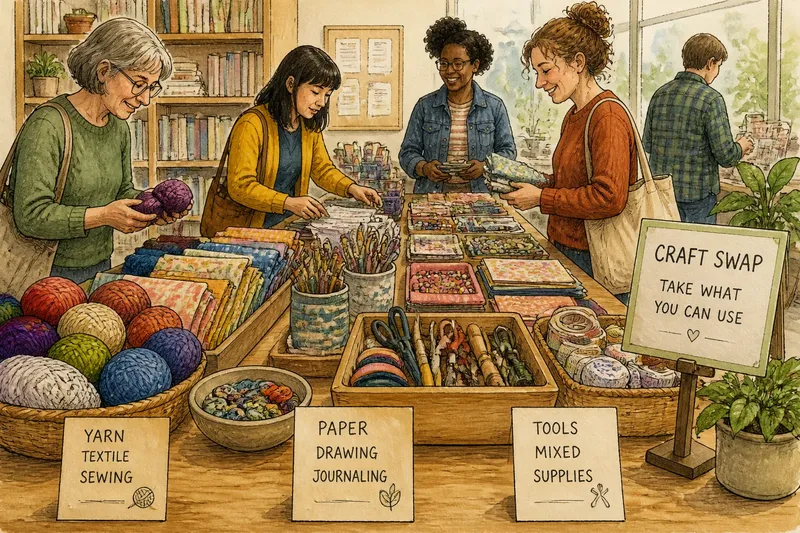
A clear craft swap format lets visitors browse without guessing whether a ball of yarn is free, reserved or available only in return for another item. Set the exchange rules before arranging the table, and people can focus on finding supplies they will use.
Choose the exchange
Keep the format easy to explain. You might invite people to bring usable craft materials and take what they can use, or ask them to trade one item for another. A direct trade asks visitors to match offers; a shared pool makes contributions available to everyone under the same rule.
Choose one approach and state it on the invitation and at the table. For a shared pool, say whether visitors may take items without bringing anything. For direct trades, explain what counts as an exchange and whether visitors may set an item aside while they look around.
Say you are hosting a small swap in a library meeting room and want visitors to browse without bargaining. You choose a shared-pool format, invite clean, usable supplies, and post a note saying people may take what they can use. Visitors can then choose without wondering whether they owe a matching object.
Questions about swap rules?
What can people bring?
Vague invitations can lead to unwanted scraps, unfinished projects or items that need repair. Name welcome categories, such as yarn, fabric remnants, beads, paper and hand tools, and ask for clean, usable contributions; list anything you do not want.
Can visitors take without bringing?
If this is unclear, people may hold back or worry they have broken an unwritten rule. State the answer on a sign at the entrance and beside the items, using the same wording in both places.
How do direct trades work?
Without a simple convention, visitors can spend more time negotiating than browsing. Say whether exchanges are item for item, whether a host can help resolve a mismatch, and what to do if someone changes their mind before a trade is agreed.
What about unsuitable items?
Damaged, dirty or incomplete supplies can make the table feel like a disposal point. Set a polite boundary in advance, and choose a host or volunteer who can move unsuitable items aside without publicly criticising the person who brought them.
Sort before display
A jumble is harder to browse than a modest selection with visible groupings. Sort materials by how visitors will recognise and use them: put yarn together, keep paper near other flat supplies, and separate tools from consumables. Keep small pieces in bowls or shallow trays so they do not scatter.
Use table zones rather than intricate labels. One end might hold fabric and sewing supplies, the centre paper and drawing materials, and the other end tools or mixed craft items. Large handwritten cards can identify these areas; labels should describe what is present, not promise a particular quality or condition.
Think of the display like a cutlery drawer: a few clear compartments make things easier to find than one deep heap. Leave open space between groups so visitors can set down an item while comparing options without burying neighbouring supplies.
Make browsing comfortable
A crowded table can make it hard to reach or inspect items. Avoid stacking fragile objects high, and place heavier items where people can lift them without leaning across delicate materials. Put free-standing signs where they do not block the view.
Give visitors a natural route along the display. Place familiar categories where they can be seen on approach, and keep less common or mixed items together rather than scattering them through every group. If several people may arrive at once, leave room for them to stand without forcing others to squeeze past.
Keep a small “needs a closer look” area for items with missing parts, uncertain contents or an attached note. A short description can help, such as “buttons, mixed sizes” or “pattern included, fabric not included.” Do not ask visitors to infer what a bundle contains from a tied bag.
Handle awkward moments
Two visitors may reach for the same appealing item. In a shared-pool swap, a first-come approach is easy to explain; in a direct-trade format, the host can invite both people to discuss an exchange or step aside briefly while they decide. Choose a convention before opening, so the person helping does not have to invent a ruling under pressure.
Some contributions will remain on the table. Decide beforehand whether contributors may take leftovers home or whether the group will arrange to pass suitable supplies to a local creative group. Do not promise a destination until it has been arranged, and make the choice clear so objects do not become an unexpected storage problem.
If a disagreement turns personal, pause the exchange and restate the posted rule rather than judging whose item is more valuable. For concerns about prohibited materials or venue requirements, follow the venue’s rules and relevant local requirements.
Opening-day checks
- Check that the exchange format appears in one plain sentence on every sign; if the wording differs, replace the signs with matching text, otherwise open with the rule visible.
- Check that welcome materials and their condition are named; if the invitation is vague, add examples and exclusions, otherwise use it to guide sorting.
- Check that the categories match the supplies on the table; if a group has no items, relabel or remove that zone, otherwise keep the category card beside it.
- Check that trays, bowls, paper labels and thick pens are ready; if any are missing, gather substitutes before opening, otherwise use them to organise and label loose supplies.
- Check that uncertain or incomplete items have a marked area and notes; if details are unknown, move them there with a clear note, otherwise place them in the appropriate category.
- Check that a host knows how to handle competing claims; if no convention has been agreed, choose and post one before opening, otherwise make sure the host can explain it.
- Check that the leftovers plan has been agreed with contributors; if it is unresolved, ask contributors to take their remaining items home, otherwise follow the agreed arrangement.
A well-planned craft swap does not need elaborate decoration or a large collection. Visible rules, sensible categories and room to look help visitors choose at their own pace. For a first craft swap, make the take-home plan just as clear as the invitation: it prevents good intentions from turning into unwanted storage.