The Pass-Along Table: How Shared Making Gets Started
A pass-along table makes shared making easier to join, with visible materials, clear invitations and a layout that welcomes both brief visits and longer work.
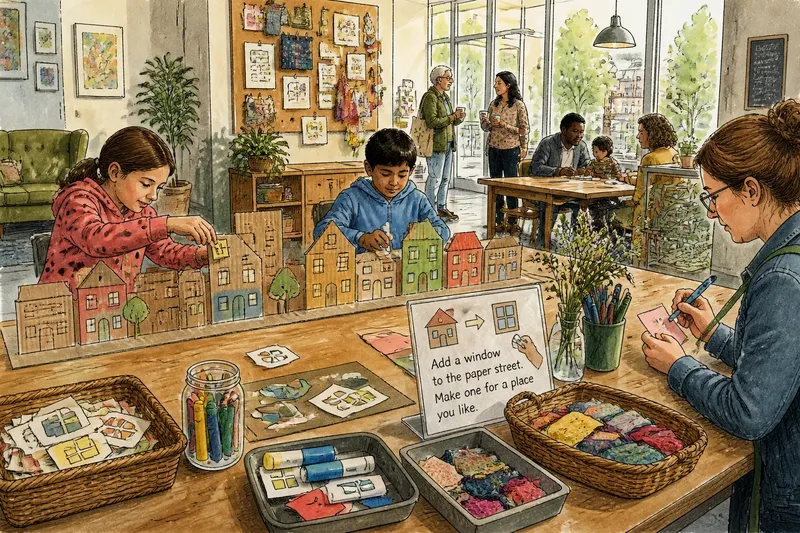
A pass-along table makes shared making easier to join when people can see what is happening, reach a material and begin without asking permission. Put a communal work surface in a room where people already pause, leave a few useful materials in view, and make the invitation specific: add a paper leaf, stitch a mark, or help finish a shared object. The table is not merely somewhere to set things down. It is a small public signal that participation is welcome.
That signal needs to work for different kinds of visitors. Some will sit for a while; others may have only a minute between errands or activities. The best setup is not necessarily the most elaborate. It is the one whose arrangement makes the next action legible, whose materials suit the setting, and whose unfinished work can wait safely for the next person.
Three ways in
A pass-along table can be organised around a continuing shared piece, a set of independent contributions, or an open-ended invitation. Each approach creates a different kind of encounter. Choose according to what people are likely to do in the space, rather than assuming every visitor wants the same depth of involvement.
One evolving object
Here, everyone contributes to the same object: perhaps a cardboard model of a neighbourhood, a paper garland, or a fabric panel with room for added patches. The object gives newcomers an immediate point of entry. They can see what others have made and add something that belongs to the same ongoing piece.
This format suits groups that want a visible thread connecting visits. It also gives the table a clear focus, which can help in a library foyer, a community café, or a school event where people pass through at different times. The trade-off is that additions affect a shared result. A simple prompt and a few boundaries—such as leaving the centre open or using only supplied fastenings—can help contributions sit together without dictating their appearance.
Separate small pieces
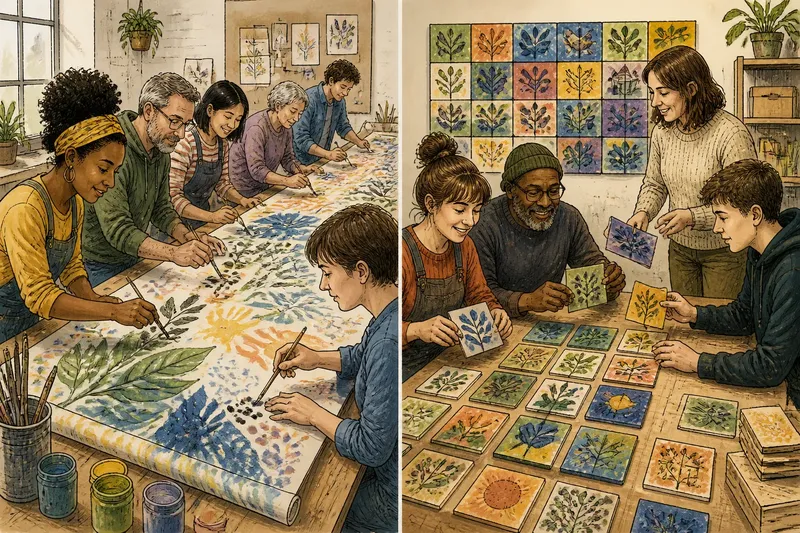
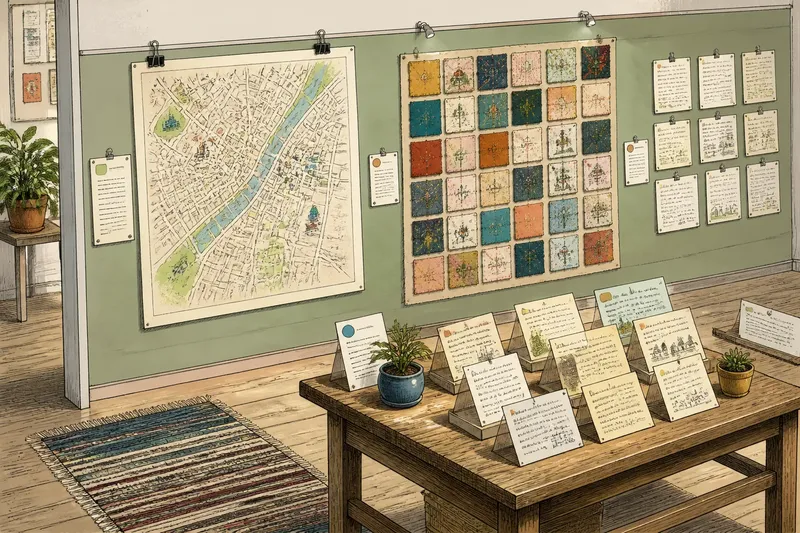
Instead of changing one central object, visitors make individual pieces that can be displayed together later. A set of stamped paper tiles, short messages on cards, or small clay shapes lets people work independently while still contributing to a collective display or collection.
This approach suits settings where visitors may prefer privacy, where taking a turn around the table is easier than joining a continuing group, or where contributions need to be stored and arranged later. Each piece can be completed on its own, so a person who leaves early has still made something finished. The organiser takes on more of the later work: sorting, presenting, or deciding how the pieces will be kept.
Open materials
An open-materials table offers a small, purposeful selection without one required outcome. Coloured paper, broad felt-tip pens, glue sticks and safe offcuts might invite people to make a sign, a tiny scene, or something they choose themselves. A prompt can point the way without closing off other ideas.
This suits groups that value experimentation and do not need every contribution to match. It asks more of the layout and the invitation: a jumble of supplies can feel like a private project already in progress, while a few visible options suggest where to begin. Keep the selection narrow enough to read at a glance, and place a finished sample nearby if the materials might otherwise seem mysterious.
Materials in view
Visibility does much of the welcoming. Put the first-use materials at the edge of the table, not behind a stack of boxes or beside tools that require explanation. A shallow tray of paper shapes, a jar of chunky crayons, or a basket of fabric strips lets someone understand the activity before deciding whether to stop.
Make the working surface readable, too. Leave one clear patch for a newcomer, keep shared tools in a predictable place, and separate supplies that have different purposes. If wet work is involved, set it apart from dry materials and show where completed pieces can rest. The arrangement should answer the quiet questions a visitor may not want to ask: Where do I start? What can I use? Where does my work go?
Think of the table as a kitchen counter set out for a shared meal: the useful things are within reach, and there is room to work without taking over someone else’s place. That everyday analogy is also a practical test. If a visitor must move someone’s project, search through containers, or guess which materials are available, the invitation is harder to accept.
Invitations that work
A short instruction should name an action, not just announce a theme. “Add a window to the paper street” gives a person somewhere to begin; “Make something about home” leaves more interpretive room but may need a visible example to make the first move feel manageable. Neither is universally better. Match the wording to the materials, the audience and the time people are likely to have.
Say a neighbourhood centre expects people to pass through while waiting for a children’s activity. The organiser puts a shared cardboard street on the table, sets out paper windows and glue sticks, and adds a sign asking visitors to make one window for a place they like. Someone who has a few minutes can attach a single shape; the expected observable result is a street that gains additions over the gathering, with no visitor needing to finish the whole scene.
That invitation works because it offers a modest action and makes the shared result visible. It does not require a visitor to explain their idea, produce a polished object or stay until the activity ends. If a group wants conversation as well as making, a host can ask an open question while people work, but should leave room for quiet participation.
Choosing the right approach
Use the setting and the desired kind of participation to choose among the three approaches. A continuing object is a strong fit when the group wants an evolving focal point. Separate pieces suit drop-in visitors who may want a finished contribution of their own. Open materials fit a group comfortable with varied outcomes and a host able to keep the invitation clear.
- Choose a shared object when a visible centrepiece will help people notice that contributions accumulate.
- Choose separate pieces when people need to finish at different times or may want to take their work with them.
- Choose open materials when exploration matters more than a uniform result and the supplies are self-explanatory.
- Reduce the choices if a first-time visitor cannot tell what to touch or where to begin.
- Add a host’s prompt if the activity makes sense only after someone explains it.
A mixed approach can work, too: keep one shared object as the focus and offer small individual pieces for visitors who would rather not alter it. Avoid setting out every possible option at once. A pass-along table invites participation by making a first move easy, not by displaying the full contents of a storeroom.
Questions about joining?
How can someone join without asking?
Place the materials and a short, visible prompt within easy reach, then leave a clearly open spot at the table. A person should be able to make a small contribution without interrupting a conversation or waiting for a host to assign a task.
What if visitors only have a moment?
Offer an action that can be started and completed in a short visit, such as choosing a paper shape and adding it to a shared surface. Keep longer tasks available as an option rather than making them the price of participation.
Should people be able to take their work home?
Decide this before setting out the materials and say so plainly. Independent pieces are easy to take away; a contribution to a continuing object usually stays with the group, so the invitation should make that distinction clear.
How much should a host explain?
Explain only what a visitor needs to begin: the prompt, which materials are available and what happens to the work. If people repeatedly hesitate at the same point, change the sign or the layout rather than relying on a longer speech.
Keep the invitation legible
Check the table from the position of someone approaching it for the first time. Can they see the activity from the room’s entrance? Is there room to set down a bag or rest an elbow? Are the tools suited to the people expected, and is there a place for finished work that will not be confused with unused materials?
For tools or materials whose safe use depends on their label, the maker’s instructions or local rules, follow that guidance and seek qualified advice where needed. For a simple paper-and-card activity, the more common obstacle is often not technical but social: a busy-looking table can make a visitor feel they have arrived too late or would disturb someone else’s work.
Keep a small patch of the surface visibly unfinished. That empty space is not wasted; it tells the next person there is room for them. A pass-along table gets shared making started when its materials, prompt and open space all say the same thing: you can begin here, and your contribution can belong.
When choosing a pass-along table format, favour the option that fits the way people actually enter and leave the room. A clear first action, an honest explanation of what happens to the work, and a place for the next person are often enough to turn a casual pause into a shared act of making.