How Shared Workshops Took Shape in Britain
Trace how British guild halls, mechanics’ institutes, artist studios and repair cafés shaped shared workshops, and see what each tradition leaves behind.
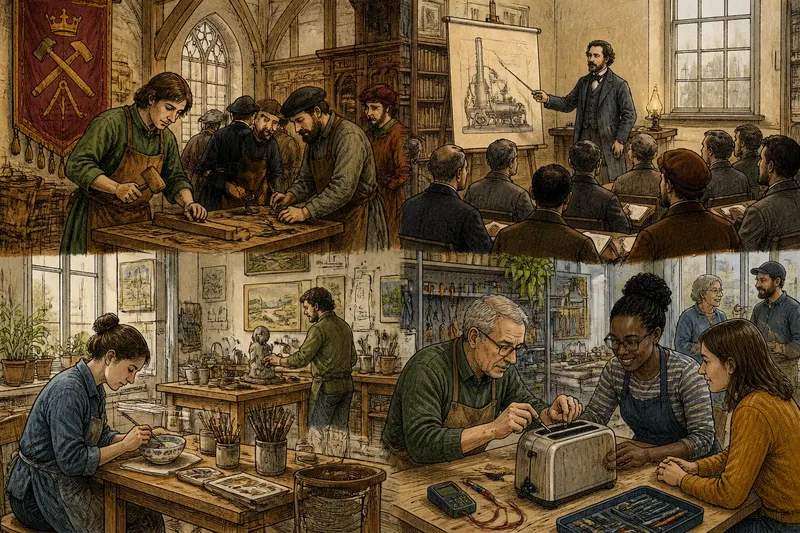
In a nineteenth-century mechanics’ institute, a local worker might attend an evening lecture on practical science; in a contemporary repair café, a neighbour might bring a broken toaster to a shared table. These scenes belong to different periods and purposes, but both show how shared workshops connect practical knowledge with a place to gather. Their history is not one smooth progression: distinct institutions developed in distinct settings.
Guilds and craft halls
In medieval and early modern English towns, craft guilds brought together people working in particular trades. Their rules could cover training, standards and membership, while guild halls provided places for meetings and civic occasions. They were not open workshops in the present-day sense, and access depended on a person’s standing within the trade and community.
That distinction matters. A guild’s shared identity and knowledge may resemble aspects of a present-day craft association, but its authority and boundaries belonged to its own period. The useful thread is the organised passing on of skills, not a claim that guild halls were early public makerspaces.
Mechanics’ institutes
During the nineteenth century, mechanics’ institutes appeared in British towns as organisations for adult education, often offering lectures, libraries and classes in practical subjects. Their exact programmes varied by place. They were educational institutions, not necessarily rooms where members could freely use tools for personal projects.
Where instruction included technical drawing or demonstrations, learning could bring practical subjects to a broader local audience. This tradition helps explain why some later community workshops combine equipment with classes: access to a tool is only part of the offer when people also need guidance to use it.
Arts and crafts rooms
Britain’s Arts and Crafts movement, which gathered momentum in the late nineteenth century, placed value on skilled handwork and the relationship between design and making. Its influence appeared in teaching, studios and craft organisations, though these settings differed in who they served and how they were run. They should not be collapsed into a single model of communal production.
In the twentieth century, artists also formed shared studios and cooperatives for reasons such as pooling facilities and working near one another. A shared studio might provide separate work areas alongside common sinks or storage; it did not necessarily offer classes or public access. The arrangement could support independent practice without making every decision collective.
Community repair rooms
More recent community workshops and repair cafés have often centred on practical help, reuse and social contact. Repair cafés, which spread internationally in the early twenty-first century, invite people to work with volunteer repairers on broken household objects. Their format differs from a permanent workshop, and the tools and services available vary by organiser.
These gatherings make knowledge-sharing visible: a visitor can watch a repair, ask questions and take part where appropriate. They also show why an open invitation is not the same as unrestricted tool access. Organisers still need clear roles and sensible boundaries around equipment.
Models in context?
What did a mechanics’ institute offer?
Many offered adult education through lectures, libraries or classes, with programmes shaped by their local organisation. They were not all equipped as hands-on workshops, so it is more accurate to see them as part of the history of public and adult learning.
Were guild halls open to the public?
Guild halls served members and civic functions, but they were not generally public workshops where anyone could arrive and use tools. Membership rules and local circumstances shaped who could participate.
How does a shared studio differ from a makerspace?
A shared studio usually gives artists a place to work, sometimes with common facilities. A makerspace more often centres on shared tools, technical learning and member projects, though the terms overlap and neither label settles who can join.
What is distinctive about a repair café?
A repair café is typically a public gathering where visitors work with volunteer repairers to mend items and share practical knowledge. It is often event-based rather than a continuously accessible workshop, and its local format determines what can be repaired.
Read the differences
These traditions answer different needs. Guilds organised a trade; mechanics’ institutes made adult learning a public activity; shared artist studios supported independent practice; repair cafés brought neighbours together around fixing useful objects. Their names are not interchangeable, and their histories do not point to a single ideal workshop.
Imagine a neighbourhood group with access to an empty shop, a workbench, hand tools and a few volunteers. It wants to host repair sessions and teach beginners, but has no plan for daily studio access. The group could schedule public repair gatherings, ask volunteers to demonstrate tasks, and reserve the tools for supervised use; the resulting format would resemble a repair café with an educational strand, rather than a members’ makerspace or artists’ studio.
Questions for local history?
- If a local record describes a guild hall, check whether it names a trade or membership rule; if it does, treat the space as trade-centred, but if it does not, avoid calling it an open workshop.
- If an institute’s prospectus lists lectures or classes, identify it as an educational organisation; if it also documents tool access, describe that hands-on provision separately, but if not, do not imply members used a workshop.
- If a studio account mentions private work areas and shared facilities, distinguish independent work from collective governance; if decisions were shared, note that structure, but if not, describe it as co-located practice.
- If a repair café notice names volunteer help and visitor participation, describe the event as collaborative repair; if tools are restricted to volunteers, state that boundary, but if visitors can handle tools under guidance, explain the supervision.
- If a source identifies a place and period, use those details to ground its history; if either is missing, qualify the claim, but do not extend it to all British workshops.
- If two organisations share a label but offer different activities, compare their documented programmes; if one teaches and the other provides workspace, keep those functions distinct, but if evidence is unclear, say so rather than forcing a category.
What the past leaves
The history of shared workshops is a history of different arrangements, not a straight line from guild hall to makerspace. British examples show how trade, adult education, artistic practice and community repair each shaped places for making in their own way.
When tracing a particular workshop’s roots, start with its name, location and documented activities; then check who could use the space and who made its rules. That small discipline keeps local history specific—and makes the word “shared” mean something more precise than a room with tools.