One Long Canvas or Many Small Pieces? Choosing a Group Artwork Format
Choosing a group artwork format shapes who can contribute, how authorship is shared and what the finished piece can become in a public space.
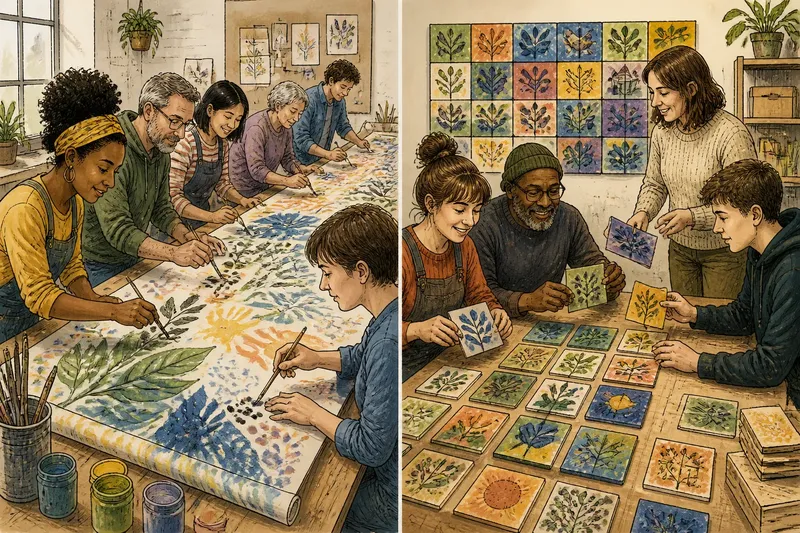
A group artwork format decides who can make a mark, how individual contributions relate and what the finished work can become in public. A single long canvas invites people to work beside one another on a shared surface; separate pieces let each person make a complete contribution before the group brings them together. That difference affects more than appearance: it shapes ownership, participation and display from the first planning conversation.
Two kinds of surface
With a collective surface, everyone works directly on the same object: perhaps a roll of heavy paper, a length of fabric or a large primed board. People may work at the same time, add marks in sequence or return to the work across several sessions. The surface itself becomes the meeting point, and each new contribution sits beside, over or in response to earlier ones.
In a modular artwork, contributors make separate units that are arranged later. These might be painted cards, stitched fabric squares, clay tiles or drawings on matching sheets. The units can retain their own edges and identities, while the final composition comes from decisions about order, spacing, grouping and mounting.
Neither format is automatically more collaborative. A long canvas can leave some people watching while confident makers take over; a set of separate pieces can give each person a clear space but leave the final arrangement to a small organising group. The useful question is not which format looks more unified, but where the project needs choice and where it needs shared decisions.
Ownership in the making
On one surface, ownership tends to be relational. A person’s mark is part of the whole, but it may be difficult to point to a precise boundary around it. Someone might add a line that another participant later paints across, or contribute a small pattern that disappears into a larger field of colour. That can suit a project whose meaning lies in interaction rather than individual pieces.
The same quality calls for care. If participants expect their contribution to remain identifiable, tell them early that marks may overlap or change. Offer ways to signal a preference, such as inviting people to initial a discreet corner, reserve a small area or choose a section that others will leave untouched. These options need not turn the artwork into a set of private territories; they simply make the terms of participation visible.
Separate contributions make attribution easier. A maker can sign a tile, choose whether to attach their name, or keep a distinct visual element within the finished work. Yet assembly still involves authorship. The person who decides which pieces sit together, what gets omitted and how the work is framed is making a creative contribution too. Agreeing who holds those decisions avoids pretending that the final arrangement appeared by itself.
A useful distinction is between authorship and custody. Contributors may jointly author the work, while a community centre, school or local group looks after it. Discuss who can move, lend, alter or eventually retire the artwork, especially if it will be displayed outside the room where it was made. Shared creative ownership is clearer when practical responsibility has a named home.
Participation at the surface
A shared canvas makes the activity visible and immediate. Participants can watch a composition change, respond to one another and join in without needing to finish a separate object. This can be inviting for people who enjoy improvisation or who want to contribute a small mark rather than complete a whole piece.
But a communal surface can also create a queue, a crowded working area or an unspoken contest for space. People who need time to observe may feel that the work has moved on before they are ready. A facilitator can offer several ways in: a quiet edge, a set of prepared shapes to add, a period when the work is left open, or a prompt that asks for one small contribution rather than a finished image.
Modular work gives each participant a more bounded task. Someone can work at a table away from the group, take a piece home if the project allows, or return a contribution later. That flexibility can help when participants arrive at different times or prefer to concentrate alone. It also makes it easier to offer varied materials or prompts without asking everyone to work in the same way.
The trade-off is that a unit can feel like an assignment rather than an invitation. If every tile must match a template, participants may have little room to make meaningful choices. A common size or shared theme can help the pieces fit, while leaving colour, image, texture or technique open. Think of the units as books on a shelf: the shelf gives them a shared place, but each spine need not look identical.
Imagine a neighbourhood group making a work for its library foyer. If evening attendance is unpredictable, the organisers could offer sturdy paper squares with a shared prompt and let people create them at drop-in sessions; later, the group could arrange the returned pieces around a central title panel. The observable result to look for is whether people can contribute on different days and still recognise how their piece belongs in the whole. If that connection feels weak, the group might add a shared border or a simple visual motif rather than require everyone to copy the same design.
Display and afterlife
A continuous surface often reads clearly from a distance. It can function as a single mural-like statement, and its uninterrupted shape may suit a long wall, a corridor or a temporary event backdrop. Before choosing it, consider how it will be carried, stored and attached. A very broad or flexible surface may need a backing or a display plan that protects it from sagging and damage.
Separate pieces offer more ways to adapt the final arrangement. They can be hung with gaps, grouped by theme, placed in a grid or arranged along a route through a room. That flexibility is valuable when the display area is uncertain, but it means the project needs a plan for spacing and support. Pieces that look complete on a table may become hard to read if they are crowded on a wall or separated too far.
Modularity can also help a work travel or change locations. Individual components may fit in boxes and be reassembled in a different room, while a single large canvas may need specialist handling or a fixed display space. If the work might be shown in more than one place, decide whether the arrangement should stay fixed or whether a local organiser may adapt it to the available wall.
Materials matter to that decision. Paper, fabric, board and tiles respond differently to light, handling, moisture and mounting. Choose supports and display methods suited to the actual venue, and follow material labels, maker instructions and local venue rules where they apply. A community hall, outdoor fence and library foyer each bring different conditions; a display that suits one may not suit another.
Choosing a format?
Which format makes individual contributions easier to recognise?
Separate pieces usually make individual authorship easier to see, especially when contributors can sign or choose a distinct feature. A shared surface can still acknowledge makers, but it works best when the group agrees how to preserve or record those contributions.
Which format suits people arriving at different times?
Modular work is often easier to keep open across staggered sessions because each person can complete a unit independently. A shared surface can also stay available, but someone will need to protect it between sessions and make clear which areas remain open.
Can a group combine both formats?
Yes: contributors can make small pieces and then add them to a common backing, or create individual panels that meet at shared edges. A hybrid only helps if the group agrees what is personal, what is collective and who decides the final layout.
What if the display location is not settled?
Separate units offer more flexibility if the available wall or room may change, while a single surface can still work if its size and mounting are adaptable. Before making anything, ask the likely venue about usable space, attachment methods and whether the work may need to move.
Make the choice together
Start by asking participants what they want the artwork to make possible: visible individual voices, spontaneous exchange, easy late entry, a strong image from across the room or the freedom to rearrange the work later. Then match the surface to those priorities rather than choosing a format simply because it seems easier to organise.
It can help to make a small paper mock-up before committing to materials. Lay out blank sheets or cut-out shapes on a table, try several arrangements and notice who gets to make the decisions. This is not a miniature version of the artwork; it is a way to uncover practical questions about spacing, labels, gaps and display before those choices become difficult to change.
For a project centred on interaction, a continuous surface may make the relationships between marks tangible. For a project that needs flexible attendance, clear individual contributions or a display that can be rearranged, separate pieces may be the better starting point. The group artwork format is part of the creative decision itself: choosing it together gives participants a say not only in what the work depicts, but in how their contributions meet.